


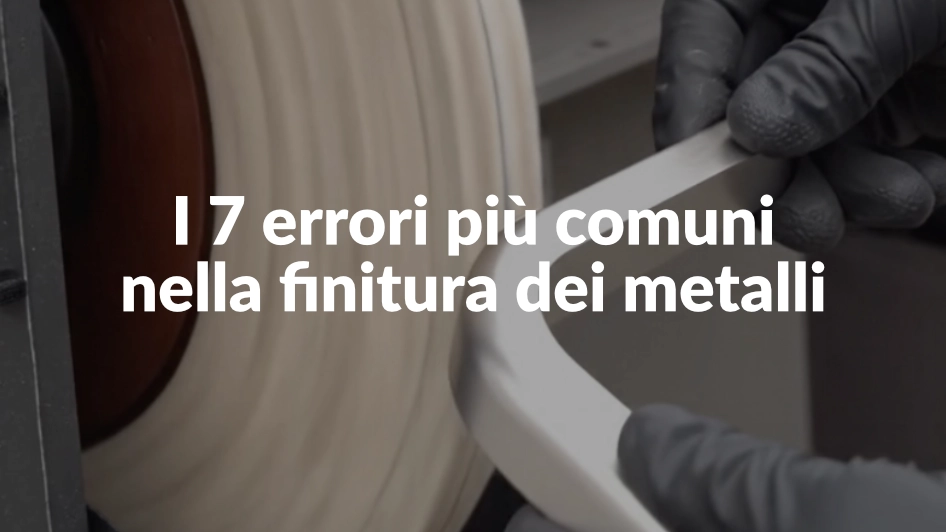
The quality of the finish does not depend solely on the disc.
When the final result does not meet expectations, the first element that is often questioned is the disc itself. In reality, in most cases, the issue is not the product being used, but how it is used.
Rotational speed, applied pressure, working angle, machine condition, workpiece material, and abrasive grit selection influence the result just as much as the disc itself.
Understanding the most common mistakes helps achieve better surface finishes, reduce scrap, and extend tool life.
Let’s look at the seven mistakes we most frequently encounter in metal finishing operations.
1. Using an unsuitable grit size
One of the most common mistakes is using the same grit size for completely different operations.
A grit that is too coarse leaves deep scratches that require additional finishing steps.
A grit that is too fine, on the other hand, unnecessarily slows down the process and reduces the material removal rate.
Recommendation: Each stage of the process should use the grit size best suited to the desired final result, following a consistent progression.
2. Applying excessive pressure
Many operators believe that applying more pressure means working faster.
The opposite is true. Excessive pressure:
- increases temperature;
- causes faster disc wear;
- reduces finishing quality;
- increases operator fatigue.
The disc should perform through its own technical characteristics, not through excessive applied force.
3. Continuing to use a worn disc
This is one of the most underestimated mistakes from an economic standpoint. When the disc loses efficiency:
- cycle time increases;
- energy consumption rises;
- surface quality deteriorates;
- the risk of overheating increases.
Replacing the disc at the right time often reduces the overall processing cost.
4. Using the wrong operating speed
Every disc is designed to operate within a specific speed range.
Excessive rotational speed may compromise both safety and product lifespan.
Conversely, a speed that is too low reduces abrasive efficiency.
Always follow the manufacturer’s recommendations and the specifications of the machine being used.
5. Neglecting machine condition
Even the best disc cannot compensate for an inefficient machine.
Vibrations, worn spindles, damaged supports, or improper clamping systems inevitably affect the final result.
Regular machine maintenance is an essential part of achieving high-quality finishing.
6. Using the same disc for different materials
Carbon steel, stainless steel, aluminum, and special alloys behave very differently.
Using the same disc for all materials means sacrificing performance.
Each material requires specific characteristics regarding:
- abrasive;
- backing;
- hardness;
- bonding system.
Choosing the correct disc allows faster and more efficient processing.
7. Considering only the disc purchase price
The purchase price represents only a small portion of the actual processing cost.
Instead, it is important to evaluate:
- disc lifespan;
- processing speed;
- finish quality;
- number of disc replacements;
- cycle time.
A higher-performance disc can significantly reduce the overall production cost.
The process makes the difference
When it comes to metal finishing, there is no universal solution.
Every operation is the result of the balance between machine, material, operator, and tool.
For this reason, at FRAID DISCHI, our job is not simply to supply an abrasive disc, but to support customers in selecting the solution best suited to their production process.
Do you have questions about choosing the right disc for your application?
Our technical team is available to analyze your process and help you identify the most efficient solution.


