


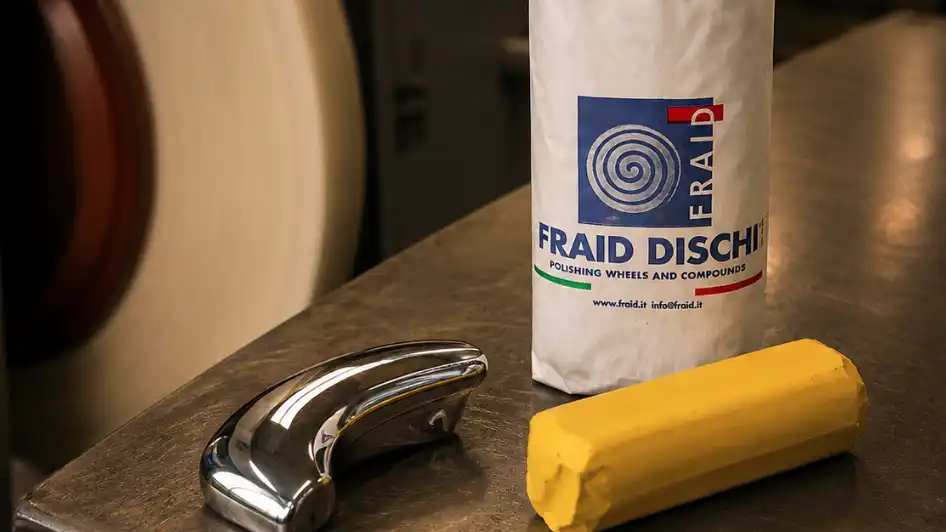
When it comes to metal polishing, attention usually focuses on the choice of the wheel, the machine or the processing technique. One element that is often underestimated is the abrasive compound, whose behaviour changes significantly depending on the ambient temperature.
For this reason, abrasive compounds do not perform in the same way throughout the year. Specific formulations are available for warmer and colder months, designed to maintain consistent performance and ensure a uniform finish.
1. Why temperature affects abrasive compounds
Abrasive compounds are made from waxes, binders and carefully calibrated abrasives.
When the temperature rises or falls significantly, the behaviour of these components changes as well.
A compound that is too soft tends to build up excessively on the polishing wheel, while one that is too hard may not transfer correctly during the process.
2. What happens in summer
During the warmer months:
- the compound softens more quickly;
- transfer onto the polishing wheel increases;
- material build-up may occur;
- the risk of surface overheating increases.
A formulation specifically designed for summer maintains a more stable consistency and allows for more controlled distribution.
3. What happens in winter
At lower temperatures, the behaviour is reversed.
The compound becomes harder and may take longer to work correctly.
A winter formulation facilitates transfer onto the polishing wheel and maintains consistent process efficiency.
4. Why using the correct formulation matters
Choosing the appropriate compound makes it possible to:
- achieve a more uniform finish;
- reduce waste;
- improve productivity;
- maintain consistent quality throughout the year;
- optimize product consumption.
Conclusion
Every detail contributes to the final result. Ambient temperature is a variable that cannot be controlled, but it can be managed by choosing the abrasive compound formulation best suited to the season. It is precisely this attention to detail that makes it possible to achieve consistent, high-quality finishing.


