


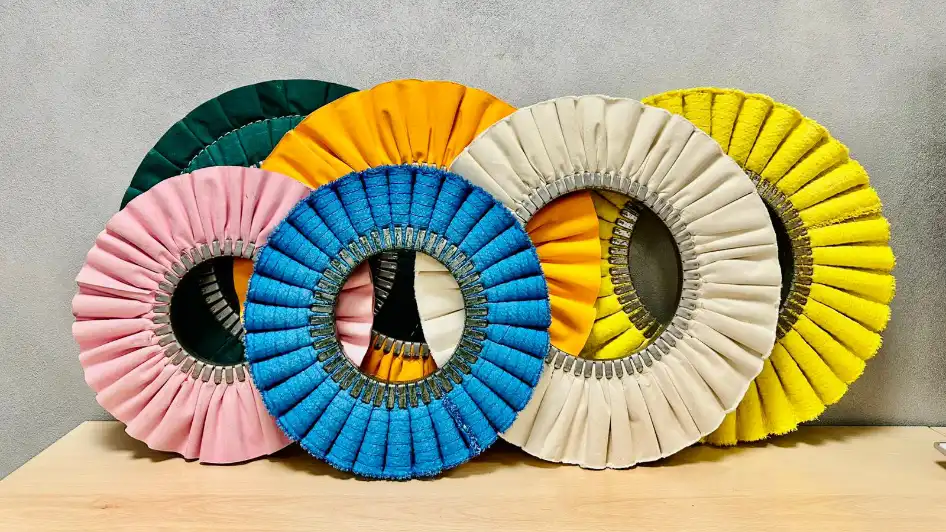
how to choose the right one for each process.
In metal finishing processes, the choice of the abrasive disc is often underestimated. It is common for the disc to be selected based on habit or availability, without a real technical evaluation.
In reality, factors such as disc shape and hardness directly affect:
- finishing quality
- result consistency
- processing times
Understanding these aspects means moving from an operational approach to a strategic and controlled one.
Abrasive disc shapes
The shape of the disc determines how it comes into contact with the workpiece and, consequently, the type of process it can perform.
Flat profile: Suitable for linear and uniform surfaces. It ensures even pressure distribution and a consistent finish.
Rounded profile: Used for edges, curves and radii. It follows the geometry of the workpiece without creating discontinuities.
Shaped profiles: Designed for complex or detailed operations. They allow processing of areas that are difficult to reach with standard discs.
Conical or edge profiles: Ideal for localized operations or specific points of the workpiece.
Why choosing the correct shape is important
The choice of profile is not just a detail, but a process variable. An unsuitable disc may cause:
- non-uniform finishing
- difficulty reaching certain areas
- increased processing times
Colors and hardness of abrasive discs
In industrial finishing, the color of the disc is not an aesthetic element, but a technical code. It identifies key characteristics such as:
- hardness level
- behavior during processing
- recommended application
Softer discs
- Greater adaptability to the surface
- Ideal for finishing operations
- Lower aggressiveness
Harder discs
- Higher material removal capacity
- Used for roughing operations
- Greater wear resistance
Most common selection mistakes
In production environments, some mistakes occur frequently:
- Choosing the disc without considering the workpiece geometry: Every shape requires a specific approach.
- Relying on color without understanding its meaning: Color is a technical indication, not a visual preference.
- Always using the same type of disc: Each stage of the process requires different tools.
How to choose the right disc
A correct selection always starts from three factors:
- material type
- workpiece geometry
- processing objective (roughing, finishing, polishing)
Integrating these elements allows:
- greater process control
- consistent results
- optimized processing times
In metal finishing, the result does not depend on a single factor, but on the combination of multiple variables. Disc shape and hardness are among the most important. Understanding them means improving not only the final result, but the entire production process.


