


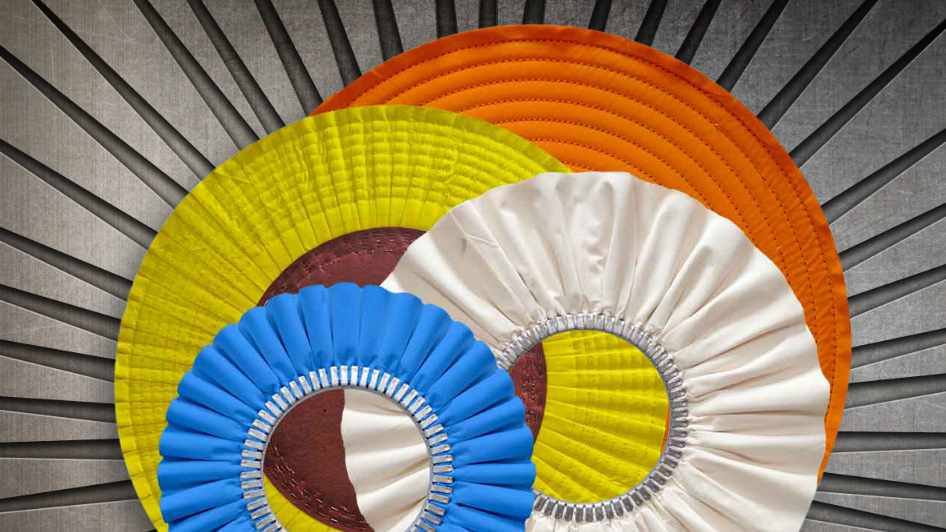
In industrial polishing, there is no single solution that is necessarily suitable for every application.
The material, workpiece geometry, machine used, processing speed and required final result are just some of the variables that can influence the choice of polishing wheel.
In many cases, a standard solution is perfectly adequate.
In others, however, specific production requirements may make it useful to develop a custom polishing wheel, designed according to the specific characteristics of the process.
Customization, however, does not necessarily mean creating a more complex product.
It means identifying the characteristics that are truly necessary to achieve the desired result as effectively as possible.
1. Every polishing process is different
Two companies may process the same material and have completely different requirements.
The geometry of the component may differ.
The machine may differ.
The production cycle may differ.
Above all, the required result may differ.
A surface intended for an aesthetic finish, for example, may require different characteristics from a component where the main objective is to achieve uniformity and repeatability in the process.
For this reason, wheel selection should always begin with an analysis of the process.
2. When a standard solution is sufficient
Customization does not necessarily mean improvement.
If a standard wheel already provides the required quality with suitable processing times and consumption levels, developing a specific solution may offer no tangible advantage.
Customization becomes valuable when it addresses a genuine production requirement.
The first question, therefore, should not be:
“Can we manufacture a custom polishing wheel?”
but:
“Does the process really require something different?”
3. When a custom polishing wheel can be useful
There are situations where a specific configuration can help improve the process.
For example, when:
- the geometry of the workpiece makes certain surfaces difficult to reach;
- a particularly uniform finish is required;
- the production cycle requires greater consistency;
- the machine has specific characteristics;
- components with particular shapes or dimensions need to be processed;
- the standard process does not achieve the desired result.
In these cases, adjusting the characteristics of the wheel makes it possible to better adapt the tool to the application.
4. What it means to customize a polishing wheel
A polishing wheel is not necessarily a product with fixed, unchangeable characteristics.
Depending on the type of wheel and the application, various construction parameters can be evaluated.
For example:
- dimensions;
- thickness;
- type and composition of materials;
- wheel construction;
- characteristics required for use on the machine;
- the configuration best suited to the application.
The objective is not to create a “different” product at all costs.
It is to ensure that the characteristics of the wheel are consistent with the process in which it will be used.
5. The wheel is only one part of the system
Even when a specific wheel is developed, it remains essential to consider the entire polishing process.
The result depends on the interaction between:
polishing wheel + abrasive compound + machine + material + processing parameters + operator.
An apparently simple modification can produce different results depending on the other variables involved.
For this reason, customization must begin with an analysis of the application, not merely the physical characteristics of the product.
6. The objective is to improve the process
A custom solution makes sense when it delivers a tangible benefit.
Depending on the application, this may mean:
- greater finishing uniformity;
- greater consistency from one workpiece to another;
- optimized processing times;
- better adaptation to the geometry of the component;
- reduced rework;
- greater overall efficiency.
The key parameter to evaluate, therefore, is not how specialized the wheel is.
It is how much that solution contributes to improving the process.
7. From supplier to technical partner
Supplying a wheel means responding to a request.
Understanding why that wheel is needed and how it will be used means becoming part of the customer’s process.
This is where technical expertise delivers real value.
At FRAID, we start from the characteristics of the application to identify the most suitable solution, assessing when a standard product is sufficient and when developing a specific configuration may be beneficial.
Because customization does not mean making the process more complicated.
When necessary, it means adapting the product to the process rather than adapting the process to the product.
Do you have a specific application or would you like to optimize your polishing process?
Talk to FRAID to identify the solution best suited to the characteristics of your production.


